Wills · 27 November 2026
Types of Wills in Malta: Public, Secret and Unica Charta
It-Tipi ta' Testmenti f'Malta: Pubbliku, Sigriet u Unica Charta
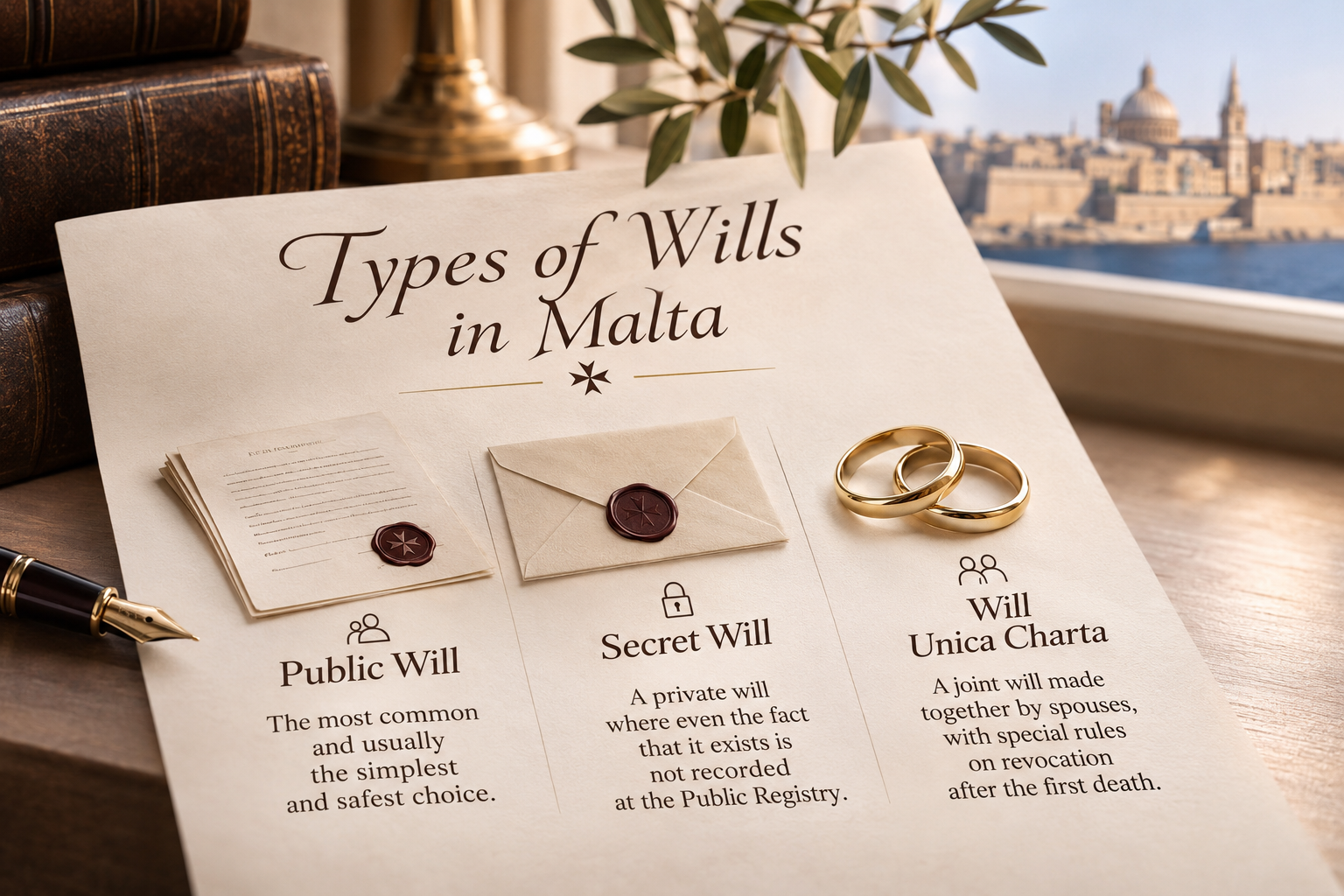
Many clients come to our office knowing that they need a will, but not that there is more than one way of making it. Maltese law recognises two ordinary forms of will, the public will and the secret will. Married couples have a further option: making one joint will together, known as a will unica charta.
All three are valid and all three can be traced after your death. The difference lies in who knows the will exists, where it is kept, and how freely it can be changed later.
The public will
The public will is by far the most common. You explain your wishes to the notary, who drafts the will, reads it to you, explains its effects and signs it with you. Witnesses are generally needed only if you ask for them or in the particular cases the law lays down.
The word "public" often worries people, so it is worth being clear: nobody can read your will while you are alive. The original stays in the notary's records. Within fifteen days the notary registers a note at the Public Registry, and that note records only that you made a will, on which date and with which notary. After your death, a search at the Public Registry leads your heirs to the will, even if you never told them which notary you used.
The secret will
A secret will goes one step further: not even the fact that you made a will is recorded at the Public Registry. The will may be handwritten in ink, typed or printed, by you or by someone you trust, and is then sealed.
You must deliver the sealed will personally, either to a notary or to a judge or magistrate of the Court of Voluntary Jurisdiction. A notary who receives one has four working days to deposit it in court, where the registrar keeps it. After your death it comes to light through a search in the court registry, which is carried out on presentation of the death certificate.
The privacy comes at a price. If you write the will yourself and hand it over sealed, nobody has checked it. An unclear clause, or a provision the law does not allow, will only be discovered when it is too late to correct.
The will unica charta
Unica charta means "one document". It is a single will made together by two spouses, and only spouses may make one: the law does not allow any other two people to make a will in the same document. In practice it is almost always made as a public will.
The will is drawn up in separate parts, one for the estate of each spouse. Very often each spouse leaves everything, or the use and enjoyment of everything, to the other, with the children inheriting after the second death.
While both spouses are alive, each may change or revoke the part dealing with his or her own estate. The important consequences arise after the first death. A will unica charta may provide that if the surviving spouse later revokes what he or she had left to the other, the survivor forfeits what was received from the deceased spouse's estate. Since the 2004 reforms this forfeiture applies only if the will expressly says so, and the notary must explain its effects before you sign. Where it applies, the property passes to the heirs named by the deceased spouse, while the survivor keeps the usufruct.
This makes the unica charta well suited to couples whose wishes are fully aligned, and less suited where flexibility after the first death matters, for example in second marriages or where there are children from different relationships. In such cases two separate wills are often the better choice.
At a glance
Public willSecret willWill unica chartaWho makes itOne personOne personTwo spouses togetherWho drafts itThe notaryYou, a person you trust, or a notaryThe notaryWhere it is keptIn the notary's recordsIn the registry of the Court of Voluntary JurisdictionIn the notary's recordsIs its existence recorded?Yes, at the Public RegistryOnly in the court registryYes, at the Public RegistryContents private during your lifetime?YesYesYesChanging it laterFreely, at any timeFreely, at any timeFreely for your own part while both are alive; possible forfeiture after the first deathWhich one is right for you?
For most people a public will is the simplest and safest choice. A secret will suits those who do not want anyone to know they have made a will at all. A will unica charta suits spouses who want their wishes to stand or fall together.
Whichever form you choose, a will is not permanent: you may replace it whenever your circumstances change, and it is the last valid will that counts.
If you would like to make a will, or are unsure whether your present will still reflects your wishes, contact our office for an appointment.
Regards,
Dr Clara Farrugia Grixti
Notary Public, Malta.
Ħafna klijenti jiġu l-uffiċċju tagħna jafu li għandhom bżonn testment, iżda ma jafux li hemm aktar minn mod wieħed kif isir. Il-liġi Maltija tagħraf żewġ forom ordinarji ta' testment: it-testment pubbliku u t-testment sigriet. Il-koppji miżżewġin għandhom għażla oħra: li jagħmlu testment wieħed flimkien, magħruf bħala testment unica charta.
It-tlieta huma validi, u t-tlieta jistgħu jinstabu wara mewtek. Id-differenza tinsab f'min ikun jaf li t-testment jeżisti, fejn jinżamm, u kemm jista' jinbidel faċilment aktar 'il quddiem.
It-testment pubbliku
It-testment pubbliku huwa bil-bosta l-aktar komuni. Inti tispjega x-xewqat tiegħek lin-nutar, li jħejji t-testment, jaqrahulek, jispjegalek l-effetti tiegħu u jiffirmah miegħek. Ġeneralment ix-xhieda huma meħtieġa biss jekk titlobhom inti, jew fil-każijiet partikolari stabbiliti mil-liġi.
Il-kelma “pubbliku” ħafna drabi tinkwieta lin-nies, għalhekk tajjeb li nkunu ċari: ħadd ma jista' jaqra t-testment tiegħek waqt li tkun għadek ħaj. L-oriġinal jibqa' fir-rekords tan-nutar. Fi żmien ħmistax-il jum, in-nutar jirreġistra nota fir-Reġistru Pubbliku, u dik in-nota turi biss li għamilt testment, f'liema data u ma' liema nutar. Wara mewtek, riċerka fir-Reġistru Pubbliku twassal lill-werrieta tiegħek għat-testment, anke jekk qatt ma għidtilhom liema nutar użajt.
It-testment sigriet
It-testment sigriet imur pass ieħor 'il quddiem: lanqas il-fatt li għamilt testment ma jiġi rreġistrat fir-Reġistru Pubbliku. It-testment jista' jinkiteb bl-idejn bil-linka, jew jiġi ttajpjat jew stampat, minnek jew minn xi ħadd li tafdah, u mbagħad jiġi ssiġillat.
Trid tikkonsenja t-testment issiġillat personalment, jew lil nutar jew lil imħallef jew maġistrat tal-Qorti ta' Ġurisdizzjoni Volontarja. Nutar li jirċievi testment sigriet għandu erbat ijiem tax-xogħol biex jiddepożitah il-Qorti, fejn jinżamm mir-reġistratur. Wara mewtek, it-testment joħroġ fid-dieher permezz ta' riċerka fir-reġistru tal-Qorti, li ssir meta jiġi ppreżentat iċ-ċertifikat tal-mewt.
Il-privatezza għandha l-prezz tagħha. Jekk tikteb it-testment int stess u tikkonsenjah issiġillat, ħadd ma jkun iċċekkjah. Klawżola mhux ċara, jew dispożizzjoni li l-liġi ma tippermettix, tinkixef biss meta jkun tard wisq biex tiġi korretta.
It-testment unica charta
Unica charta tfisser “dokument wieħed”. Huwa testment wieħed magħmul flimkien minn żewġ konjuġi, u l-konjuġi biss jistgħu jagħmlu testment bħal dan: il-liġi ma tippermettix li xi żewġ persuni oħra jagħmlu testment fl-istess dokument. Fil-prattika, kważi dejjem isir bħala testment pubbliku.
It-testment jitfassal f'partijiet separati, waħda għall-wirt ta' kull konjuġi. Ħafna drabi kull konjuġi jħalli kollox, jew l-użu u t-tgawdija ta' kollox, lill-konjuġi l-ieħor, u t-tfal jirtu wara l-mewt tat-tieni wieħed.
Waqt li ż-żewġ konjuġi jkunu għadhom ħajjin, kull wieħed minnhom jista' jbiddel jew jirrevoka l-parti li tittratta l-wirt tiegħu jew tagħha. Il-konsegwenzi importanti jinqalgħu wara l-ewwel mewt. Testment unica charta jista' jipprovdi li, jekk il-konjuġi superstiti aktar tard jirrevoka dak li jkun ħalla lill-ieħor, is-superstiti jitlef dak li jkun irċieva mill-wirt tal-konjuġi mejjet. Mir-riformi tal-2004 'l hawn, dan it-telf japplika biss jekk it-testment jgħid hekk espressament, u n-nutar irid jispjega l-effetti tiegħu qabel ma tiffirma. Fejn japplika, il-proprjetà tgħaddi għand il-werrieta maħtura mill-konjuġi mejjet, filwaqt li s-superstiti jżomm l-użufrutt.
Għalhekk it-testment unica charta huwa adattat ħafna għal koppji li x-xewqat tagħhom jaqblu għal kollox, u inqas adattat fejn il-flessibbiltà wara l-ewwel mewt tkun importanti, pereżempju f'żwieġ għat-tieni darba, jew fejn hemm tfal minn relazzjonijiet differenti. F'każijiet bħal dawn, żewġ testmenti separati ħafna drabi jkunu l-aħjar għażla.
Ħarsa ħafifa
| Testment pubbliku | Testment sigriet | Testment unica charta | |
|---|---|---|---|
| Min jagħmlu | Persuna waħda | Persuna waħda | Żewġ konjuġi flimkien |
| Min ifasslu | In-nutar | Inti, persuna li tafdaha, jew nutar | In-nutar |
| Fejn jinżamm | Fir-rekords tan-nutar | Fir-reġistru tal-Qorti ta' Ġurisdizzjoni Volontarja | Fir-rekords tan-nutar |
| L-eżistenza tiegħu tiġi rreġistrata? | Iva, fir-Reġistru Pubbliku | Biss fir-reġistru tal-Qorti | Iva, fir-Reġistru Pubbliku |
| Il-kontenut jibqa' privat waqt ħajtek? | Iva | Iva | Iva |
| Bidliet aktar tard | Liberament, f'kull ħin | Liberament, f'kull ħin | Liberament għall-parti tiegħek waqt li t-tnejn ikunu ħajjin; telf possibbli wara l-ewwel mewt |
Liema wieħed huwa l-aħjar għalik?
Għall-biċċa l-kbira tan-nies, it-testment pubbliku huwa l-aktar għażla sempliċi u sigura. It-testment sigriet jaqbel għal min ma jridx li ħadd ikun jaf li għamel testment. It-testment unica charta jaqbel għal konjuġi li jridu li x-xewqat tagħhom jibqgħu jew jaqgħu flimkien.
Ikun liema jkun il-mod li tagħżel, testment mhuwiex permanenti: tista' tibdlu kull meta jinbidlu ċ-ċirkostanzi tiegħek, u huwa l-aħħar testment validu li jgħodd.
Jekk tixtieq tagħmel testment, jew m'intix ċert jekk it-testment li għandek bħalissa għadux jirrifletti x-xewqat tiegħek, ikkuntattja l-uffiċċju tagħna għal appuntament.
Tislijiet,
Dr Clara Farrugia Grixti
Nutar Pubbliku, Malta.
Din il-verżjoni bil-Malti hija tradotta awtomatikament. F'każ ta' dubju, jgħodd it-test oriġinali bl-Ingliż.